Making Search Engine from Scratch
Mar 2026
Shoutout from Pak Alfan
I’m incredibly honored to have my work on the CSCE604135 Web Search & Information Retrieval course featured by Pak Alfan. The challenge was to move beyond high-level libraries and build a search system from the ground up.
This project was a deep dive into the engineering trade-offs of Information Retrieval. I focused on balancing indexing speed, storage efficiency, and retrieval accuracy.
Dual Indexing Strategies
I implemented both BSBI (Block-Sort-Based Indexing) and SPIMI (Single-Pass In-Memory Indexing). This allowed me to compare fixed-block memory usage against more dynamic, memory-efficient sequential processing.
Bit-Level Compression
To minimize disk footprint, I built custom codecs for Elias-Gamma Coding and Variable Byte Encoding (VBE). My benchmarks showed that bit-level universal coding significantly outperforms standard 32-bit storage, which is crucial for scaling to large document collections.
Dictionary Optimization
Navigating the vocabulary efficiently is key. I utilized Patricia Trees to manage the dictionary, visualizing the prefix-based structure to ensure fast term lookups. To truly understand the prefix-sharing and structure of the entire vocabulary, I generated three distinct interactive visualizations for learning purposes:
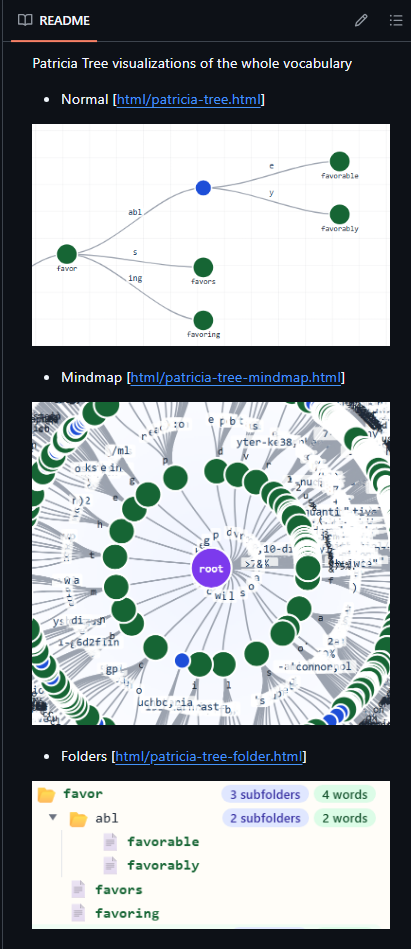
Patricia Tree Visualization
Hybrid Retrieval (Sparse + Dense)
While traditional BM25 is great, I pushed the project further by integrating LSI (Latent Semantic Indexing) and FAISS (Facebook AI Similarity Search). By using Randomized Truncated SVD and HNSW/IVF indexing, the engine provides semantic search capabilities with a ~9.3x speedup over brute-force methods.
Interactive UI
To tie it all together, I developed a Flask-based frontend, allowing for real-time query testing across all implemented backends.
Evaluation
Using metrics like NDCG, MAP, and RBP, I verified that the LSI+FAISS approach provided the highest ranking quality and efficiency across the board.